
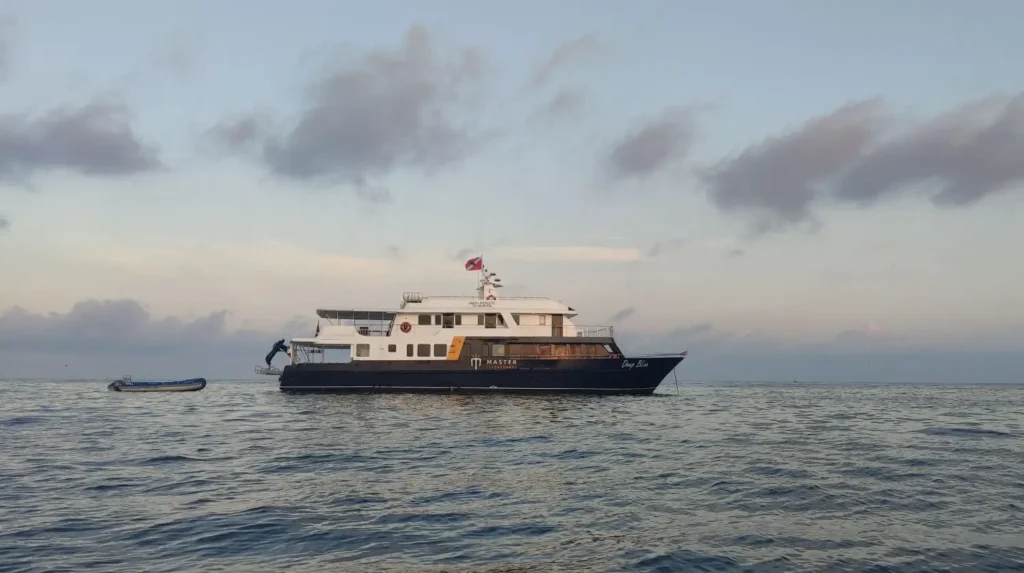
Galapagos Master delivers what many scuba divers consider the trip of a lifetime: a seamless, expert-led expedition into the heart of the Pacific’s most famous archipelago. She’s your gateway to the remote northern islands of Darwin and Wolf, where the chance of big pelagic encounters is the reason most divers come and, for a week, she’s also your home, your dive base and the place where every story gets told.
By combining a purpose-built steel vessel with a crew whose local knowledge spans decades, Galapagos Master turns a challenging bucket-list trip into a safe, deeply rewarding, and community-focused adventure. For those seeking encounters with hammerhead schools and whale sharks, this is where the journey begins.
Quick Summary
- Iconic Expeditions: Purpose-built for remote, challenging waters with a focus on stability and safety.
- The “Big” Stuff: Itineraries spend three days at Darwin and Wolf Islands, home to large schools of hammerheads and seasonal whale sharks.
- Expert Led: Years of local experience ensure safety-led dive planning in advanced conditions.
- The Right Experience: Designed for confident, experienced divers ready for currents and thermoclines.
- Onboard Community: A blend of comfort and camaraderie, where the shared passion for marine life creates a unique social atmosphere.
- Book Direct: Booking via Master Liveaboards ensures consistent standards and expert oversight.
More Than a Boat: A Front-Row Seat to Nature at Its Wildest
You wake to the sound of frigate birds circling overhead, their silhouettes sharp against the dawn. The engines hum with a steady, reassuring rhythm as Galapagos Master makes her way towards Darwin Island, the northernmost point of your journey. There’s a specific kind of electricity in the air during the morning briefing; it’s the collective excitement that today could be the day a wall of scalloped hammerheads fills the blue, or a bus-sized whale shark glides into view.
On a diving liveaboard in the Galápagos, you aren’t just a tourist; you are an observer of an ancient, wild world. The boat isn’t just a place to eat and sleep between dives; it’s your front-row seat to one of the greatest shows on Earth. Every pre-dive check, every shared meal, and every sunset crossing is infused with the anticipation of what lies beneath tomorrow.
Why Galapagos Master Is Built for This Expedition
The waters surrounding the Galápagos Islands are not a place for the faint of heart or the unprepared. To reach the most iconic dive sites, you must cross vast stretches of open ocean where conditions can change in a heartbeat.
Designed for Remote, Demanding Waters
Galapagos Master is a deep-sea veteran. Constructed with a steel hull that sits low in the water, she was designed to handle the often-choppy crossings between the central islands and the remote northern outposts. Unlike lighter vessels that might bounce on the swell, this boat offers the weight and displacement necessary for a comfortable journey through the Humboldt and Cromwell currents. Her long-range capability means you spend more time at the dive sites and less time worrying about the logistics of the journey.
Comfort Without Compromising Adventure
While the focus is firmly on the water, the experience topside is designed to support the physical demands of up to four dives a day.
- Comfortable Cabins: Each cabin has its own climate control and an ensuite with a hot water shower, which you’ll appreciate when you’re trying to warm up after a chilly dive.
- Thoughtful Layout: From the dedicated camera station for photographers to the expansive sun deck, the boat is laid out to ensure you never feel cramped, even when the excitement of a recent sighting has everyone talking at once.
- Safety as Standard: Everything from the heavy-duty dive tenders (pangas) to the safety of divers is geared toward one goal: allowing you to focus on the marine life while the crew handles the complexity.
The Itinerary: Accessing Places Few Divers Ever Reach
The true value of a Galapagos Master itinerary lies in its balance. It doesn’t just throw you into the deep end; it guides you through the diversity of the archipelago.
Balanced Routes Across the Archipelago
The adventure begins in the central islands, with some relatively easy dives near Baltra, before heading north. These sites have their own kind of magic:
- Macro & Mid-range: Find seahorses, frogfish, and nudibranchs nestled in the reefs while eagle rays and solitary sharks cruise by.
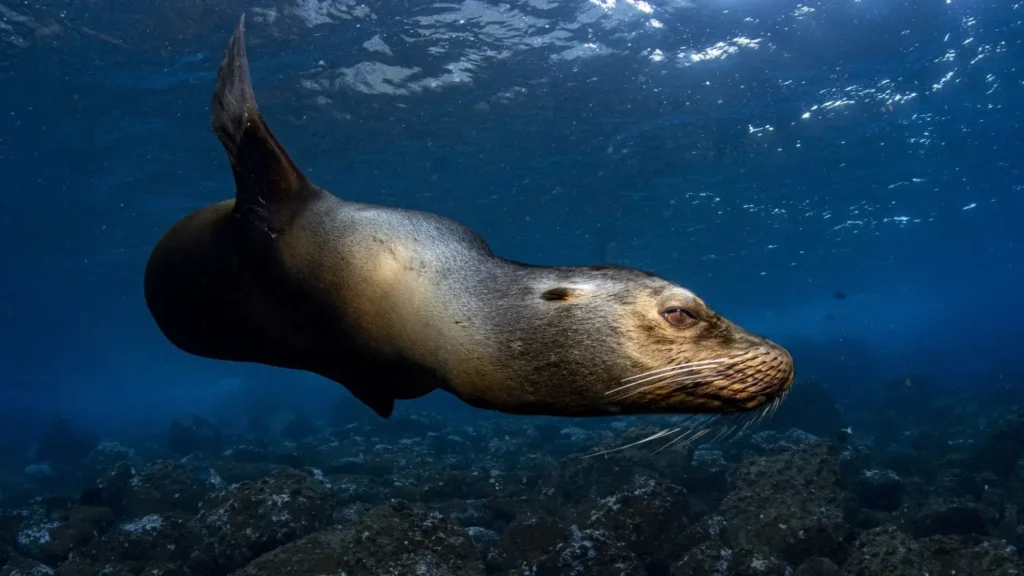
- The Playful Locals: An introduction to what will become a feature of the trip: the chaotic joy of diving with Galápagos sea lions.
The Build-up: This gradual start allows divers to check their buoyancy and get accustomed to the cooler water before hitting the high-voltage sites in the north.
Darwin & Wolf: The Crown Jewels
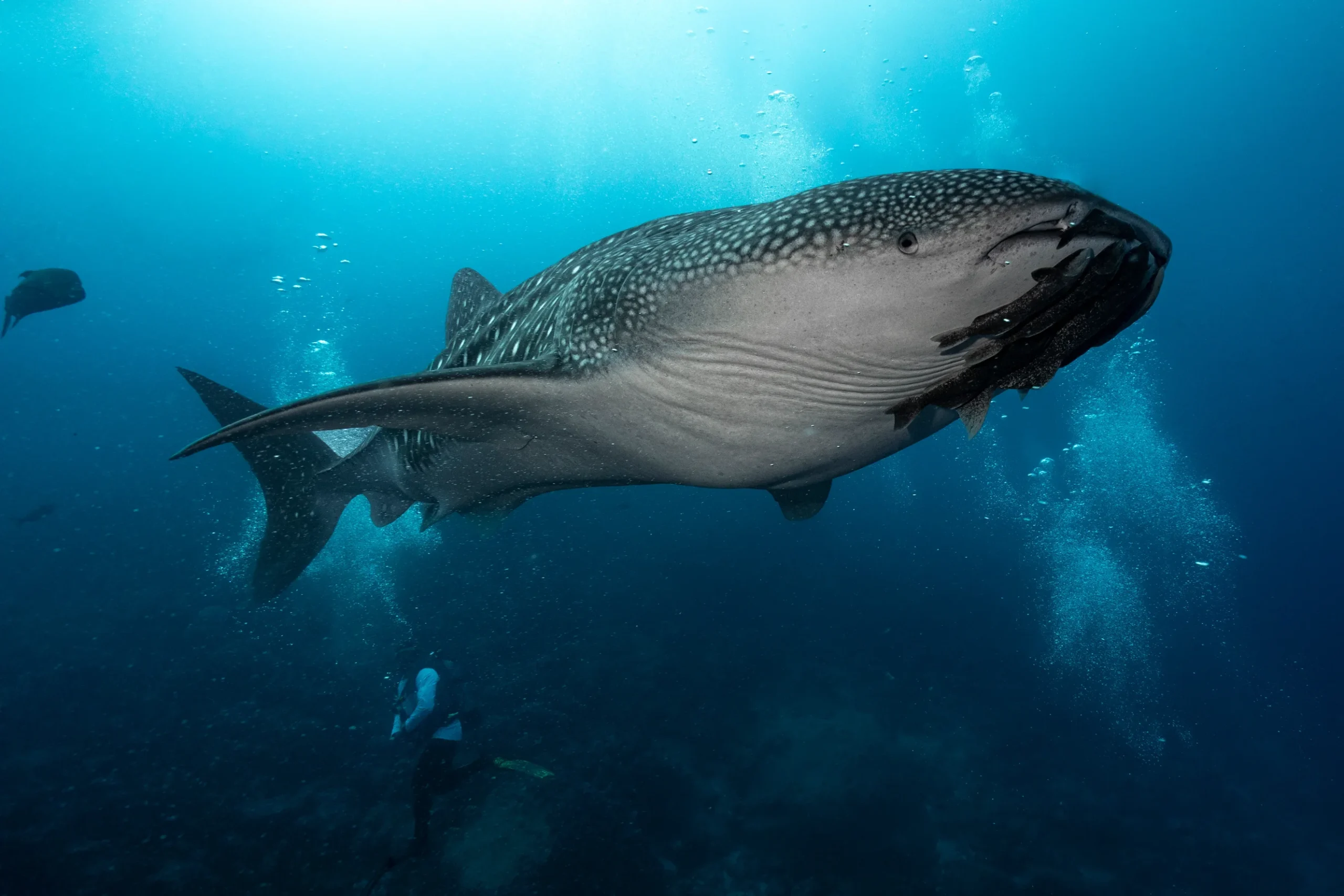
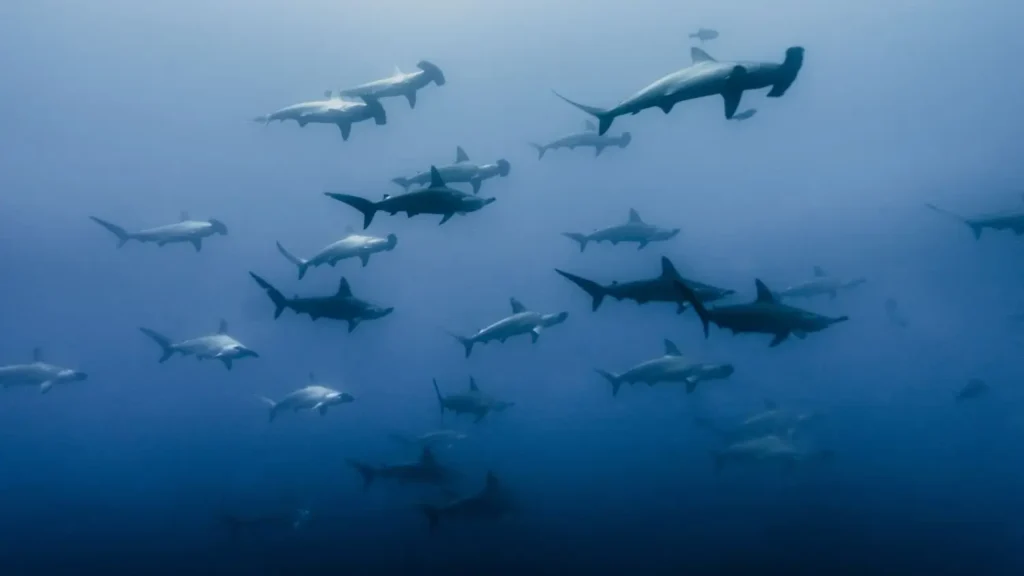
For many, the journey is defined by the days spent at Darwin and Wolf. These tiny volcanic remnants are the epicentres of pelagic action, and their isolation makes them magnets for migratory species. You aren’t just looking for a single shark; you’re looking for school after school of hammerheads. During the right season, the massive shadows of whale sharks can appear out of the blue, accompanied by the frantic energy of Galápagos sharks and the graceful passage of eagle rays.
The Western Islands
After Darwin and Wolf, the route returns south to Isabela and Fernandina, where the water turns noticeably colder and the marine life changes with it. Marine iguanas graze in the shallows, penguins dart between the rocks, and there’s always the chance of a mola mola rising from the deep at Punta Vicente Roca. The diving itinerary finishes mear Santiago Island at Cousin’s Rock, a colourful wall where it’s hard to know which way to look: out into the blue for passing sharks and eagle rays, or amongst the black coral for seahorses
The Diving Experience: Challenging, Rewarding, Unforgettable
Let’s be honest: Galápagos diving can be intense. It’s work. But on Galapagos Master, the hardest part of that work is managed by a team that understands the rhythm of these waters.
Advanced Conditions Done Right
In the Galápagos, you will encounter currents that require you to find a sturdy rock to hold onto… or to hide behind. You’ll hit thermoclines where the temperature can drop five degrees Celcius (9°F) in a matter of metres (remember: focusing on the temperature coming back up will sustain you!). You’ll do some blue-water drifts too, hanging in the vast emptiness while waiting for the pelagics to pass and/or making your safety stop.
We don’t sugarcoat these conditions because the challenge is part of the reward. There’s a real sense of accomplishment in navigating a washing-machine current and being rewarded with a view of schooling hammerheads overhead.
Expert Briefings & In-Water Support
The crew’s expertise is the bridge between a stressful dive and a spectacular one.
- Precise Planning: Briefings are detailed, covering entry points, current direction, and what to do if you get separated.
- Safety-Focused Positioning: The panga drivers are underappreciated artists, tracking bubbles in heavy swells to ensure you are picked up the moment you surface.
- Calm Leadership: Our dive guides don’t just point out fish; they read the water, knowing exactly where to position the group to see the action without fighting the current unnecessarily.
Marine Life That Redefines “Big”
In the Galápagos, “big” is often an understatement. This is one of the few places on the planet where the biomass is so high that sightings feel consistent rather than lucky.
- Scalloped Hammerheads: The quintessential Galápagos experience. On a good day at Darwin or Wolf, they pass overhead in schools thick enough to almost block out the sun.
- Whale Sharks (June–November): Most are large females that appear to be pregnant passing through the northern islands. Their size is staggering, often exceeding 11 metres (36 feet).
- Marine Iguanas: The world’s only lizards that feed in the sea. Watching them graze on algae in the surge is like watching a miniature Godzilla movie through your own mask.
- Sea Lions & Fur Seals: Curious and agile, they often zoom through groups of divers, providing some of the best “interaction” moments of the trip.
- The Unusual Suspects: Mola mola (sunfish) in the deeper, colder waters, red-lipped batfish on the sandy bottoms, and schools of barracuda that create silver vortices around you.
Life Onboard Galapagos Master
The magic of a Galápagos liveaboard experience happens in the spaces between the dives.
A Community of Like-Minded Divers
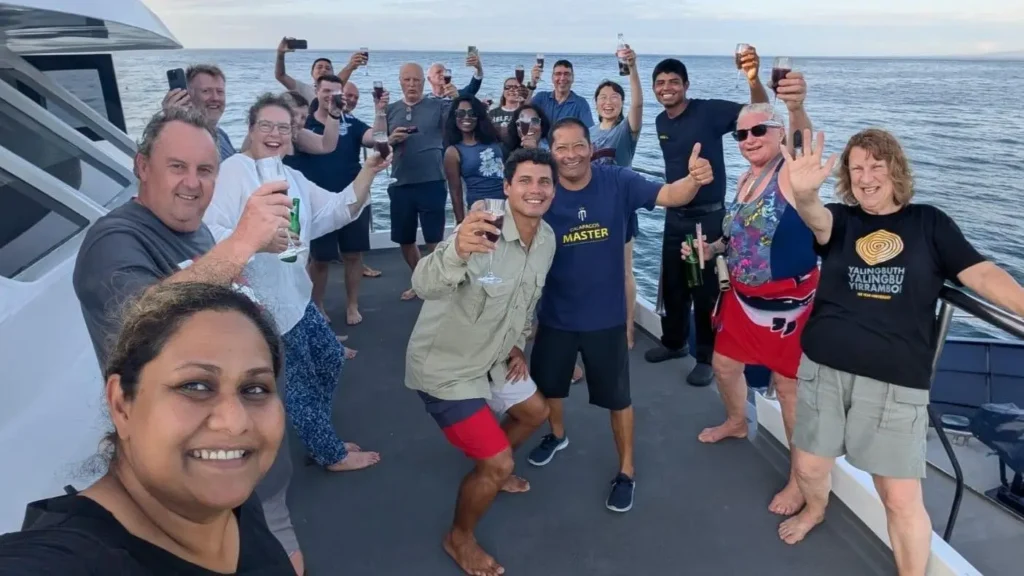
There’s a unique bond that forms when sixteen people from different corners of the globe share a “hammerhead high.” The lounge becomes a hub of storytelling, photo swapping, and shared anticipation. You aren’t on a boat with strangers for very long; you are part of a temporary but close tribe of explorers.
Crew Who Know These Waters Inside Out
Many of our crew members have been sailing the Galápagos for decades. They don’t just know where the sharks are; they know the history of the islands, the nuances of the weather, and how to make a guest feel at home in the middle of the Pacific. This personal, attentive service is what turns a good trip into a legendary one, and is one of the things guests mention most in their trip reviews.
Between-Dive Moments That Matter
- Wildlife Spotting: Keep your binoculars ready for dolphins riding the bow wave or whales breaching in the distance.
- Sunset Briefings: There is nothing quite like a briefing on the sun deck as the sky turns orange and the silhouette of Wolf Island looms on the horizon.
- Shared Meals: Hearty, delicious food created to refuel divers who have spent the day battling currents.
Who Is This Trip Really For?
To ensure everyone has the best possible experience, it’s important to be clear about who will enjoy Galapagos Master the most. This is an expedition, not a resort stay and requires a specific mindset and experience level.
- Experienced Divers: We require all divers to have at least 50 logged dives, preferably with experience in currents and cold water.
- Advanced Certification: Due to the depths and challenging conditions, Advanced Open Water is the standard.
- Nitrox Certified: To maximise your bottom time with the sharks and stay within safe deco limits over 20+ dives, diving with Nitrox is mandatory.
- The Adventure Seeker: If you prefer easy diving with no current and 30-metre (100 ft) visibility every time, the Galápagos might be a shock. If you want high-octane action and are comfortable with the wildness of the ocean, this is your paradise.
Why Book With Master Liveaboards?
When you’re booking a “bucket list” trip, the “who” is just as important as the “where.” Booking directly with Master Liveaboards offers security and a level of service that most third-party Online Travel Agencies (OTAs) simply cannot match.
- Direct Operator Expertise: We’ve worked closely with the vessel owners from day one and are involved in the boat’s operational procedures. When you ask a question, you’re talking to the people who know the boat’s layout, the crew’s names, and the exact itinerary details.
- Consistent Standards: We maintain rigorous safety and service protocols across the entire Master Liveaboards fleet. We work directly with the boat owners, so there is no middleman disconnect.
- Accountability: If something changes, whether it’s the weather or logistics, you have a direct line to the people making the decisions. We are invested in your experience from the moment you enquire until you step off the gangway.
When to Go: Choosing the Right Galápagos Season
We’ve said this before, but it’s true: There is no “bad” time to visit the Galápagos. That said, the experience changes significantly depending on the month.
| Season | Months | Water Temps | Highlights |
|---|---|---|---|
| Cool Season | June – Nov | 18°C – 25°C (64°F–77°F) | Cooler water, more plankton (lower visibility but more life). Largest hammerhead schools, whale shark sightings at Darwin. |
| Warm Season | Dec – May | 20°C – 26°C (68°F–79°F) | Warmer water, calmer seas, better visibility, peak Manta ray sightings. |
| Year-Round | Jan – Dec | As above | Scalloped hammerheads, sea lions, turtles, and Galápagos sharks are always present. |
Frequently Asked Questions
While we welcome everyone, the Galápagos is an advanced destination. If it is your first-ever liveaboard, ensure you are very comfortable with currents and deep diving. Many divers find it helpful to have a more “relaxed” liveaboard experience under their belt first.
It ranges from moderate to difficult. Expect strong surges near the rocks and significant currents at Darwin and Wolf. You will need to be comfortable with negative entries (descending immediately upon hitting the water).
The vessel is incredibly stable in rougher seas compared to wooden vessels. Additionally, as part of the Master Liveaboards fleet, she benefits from a global network of dive travel expertise and safety standards.
In nature, there are no guarantees. However, during the peak months (August to September), Darwin Island is one of the few places in the world where you have a realistic chance of seeing large adult females.
It varies by site as well as throughout the year. You might have 26°C (79°F) at the surface and hit a thermocline that drops by up to 5°C (9°F) at depth. At Darwin and Wolf temperatures are consistently around 24°C to 25°C (75°F to 77°F), but in the western islands, upwellings can bring it down to 15°C (59°F) or lower. A 5mm or 7mm wetsuit or semi-dry with a hood and gloves is the standard minimum for most divers.
Dive the Galápagos the Right Way
This isn’t just another dive trip; it’s an expedition led by people who live and breathe the Galápagos. Galapagos Master offers more than a cabin and a tank; she offers the peace of mind that comes with years of experience in one of the world’s most demanding environments.
Are you ready to witness the walls of hammerheads for yourself? To stand on the deck as the sun sets over Darwin’s Pillars of Evolution? Don’t leave your bucket-list trip to chance.