
The engine hum of Galapagos Master changes pitch as it throttles down. You are miles from the main archipelago, bobbing in the open Pacific swell. Ahead of you rise the two stone pillars that remain of the iconic Darwin’s Arch. Even from the surface, the water looks different here. It churns with an energy that only hints at the immense forces moving beneath.
This is not a site for the tentative.
To dive Darwin’s Arch is to enter one of the wildest, most dynamic marine environments on Earth. It is the pinnacle of Galápagos liveaboard diving, shaped by colliding oceanic currents that create difficult conditions, but also fuel an ecosystem of unrivalled biomass. For the advanced diver, this is the ultimate test of buoyancy, situational awareness, and technical discipline.
This guide is designed for experienced divers preparing to face the surge. We’ll break down the hydrodynamics of the site, the specific techniques required for safe entry and positioning, and why mastering these currents is the price of admission to one of the world’s greatest shark encounters.
Quick Summary: What’s the Deal?
For those reading this while also watching Netflix while looking for bedtime reading, here’s your technical snapshot of what to expect at Darwin’s Arch:
- Hydrodynamics: One of the world’s strongest current environments, featuring unpredictable upwellings, downcurrents, and surges.
- Entry Protocol: Strictly negative entries. Divers must be comfortable dropping immediately to depth without surface checks.
- Wildlife: The high current brings the pelagics. Expect massive schools of scalloped hammerheads, seasonal whale sharks, and huge tuna.
- Safety: SMB proficiency and strict adherence to guide ratios are non-negotiable.
- Vessel: Due to the remote location and conditions, this site is managed best from a specialised liveaboard vessel like Galapagos Master.
- Verdict: An excellent site for experienced divers seeking the best of conditions versus rewards.
Understanding the Currents at Darwin’s Arch
To master Darwin’s Arch fully, you must first understand the physics of the water moving around it. The island acts as a massive barrier in the middle of a hydrological superhighway.
The Convergence of Giants
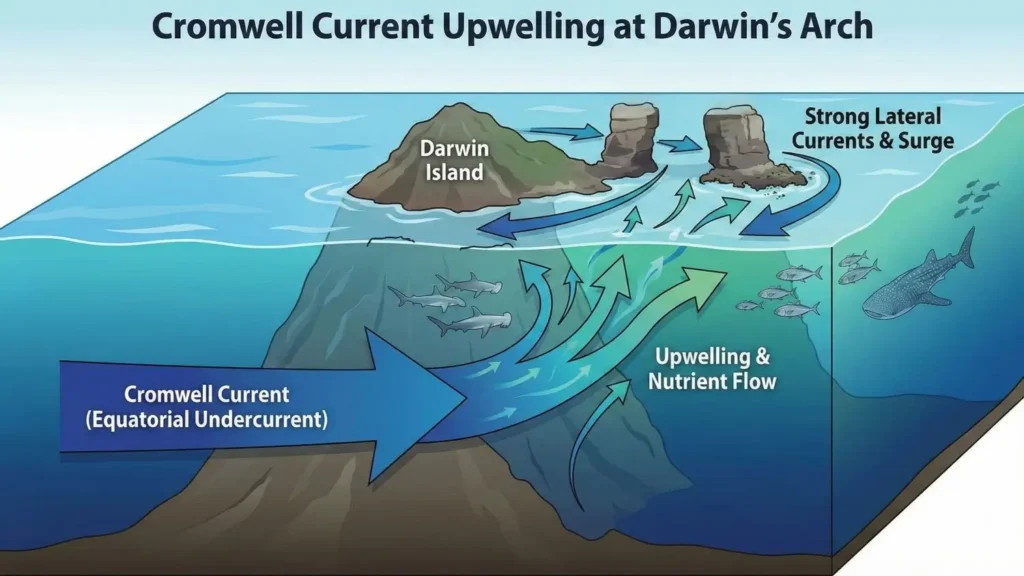
Darwin Island sits at the confluence of major oceanic flows. The most significant player here is the Cromwell Current (Equatorial Undercurrent). You were expecting us to say Humboldt, right? Wrong. This cold, nutrient-dense river of water flows eastward along the equator at depth. When it collides with the western face of the Galápagos platform, specifically Darwin and Wolf, it is forced upward.
This massive upwelling brings cold, oxygen-rich, and nutrient-loaded water from the deep ocean to the surface. It is the reason the marine life here is so explosive, but it also creates the “washing machine” effect that divers often experience.
Simultaneously, you are dealing with the warmer Panama Current from the north and the Humboldt Current (the glory hog) driving from the south. These are the currents that tend to drive the change in species throughout the year.
The Dive Environment
These colliding forces create a specific set of challenges:
- The Jet Stream: Currents here regularly and easily exceed 3 knots and peak as high as 5 knots. Whatever you believe, you cannot swim against this; you must navigate with it or find shelter from it.
- Downcurrents: As water hits the reef wall and splits, it can be driven downward with force. Recognising the “waterfall” effect of bubbles or fish swimming vertically, before you hit it, is a key skill.
- Surge: At safety stop depth, the ocean swell translates into powerful horizontal surge, potentially (sometimes actually) pushing divers back and forth toward the barnacle-encrusted rocks.
Entry Techniques: Getting in Safely
At Darwin’s Arch, the dive begins the moment the skiff (panga) engine cuts. Try not to be awed by the pillars that are all that remains of the arch since its collapse in 2021, and focus. Be ready, because there is no time for gear adjustments on the surface. The current on the surface is often moving faster than the current at depth, meaning a delay of thirty seconds can result in drifting half a mile past the dive site.
The Negative Entry
The standard operating procedure here is the Negative Entry.
- Preparation: All air is dumped from your BCD before the roll. Regulators are in mouths. Cameras are secured close to the chest.
- The Signal: On the panga captain or guide’s count, the group back-rolls simultaneously.
- The Descent: Do not stop on the surface! Breathe out and kick immediately down toward the reef, aiming to get below the high-velocity surface water. The target is usually a shelf or rock slope at approximately 15 to 20 meters (50 to 65 feet).
Handling Missed Drops
Even with experienced divers, the ocean sometimes wins. If you cannot equalise or you drift off the site immediately, the protocol is to just abort. You surface, regroup on the panga, and reset. Fighting a missed drop by trying to beat the current consumes dangerous amounts of gas and accumulates CO2, increasing the risk of panic and impaired decision-making. None of these is good.
Equipment Recommendation: Streamlined gear is essential. Large strobes on cameras should be folded in during entry to reduce drag. Ensure your weighting is calibrated for a full-lung exhale descent.
Managing Strong Currents Underwater
Once you’ve stuck the landing, the dive transitions to “The Theatre”. This is the ledge where divers position themselves to watch the pelagic show. Staying there requires technique.
Body Positioning & Hydrodynamics
The goal is to present the smallest possible surface area to the flow.
- Horizontal Trim: Essential. Being vertical turns you into a sail.
- The Low Profile: Get close to the substrate (without crushing marine life). The water speed is significantly slower within 1 or 2 feet of the bottom due to friction.
- Slipstreams: Use the rock formations. Just like a cyclist drafting, tucking behind a large boulder can provide a pocket of calm water, allowing you to catch your breath and check gauges.
Reef Hooks & Grip Points
In currents of this magnitude, finning to stay stationary is inefficient and spikes your air consumption. This is where mechanical aid comes in (that’s ‘holding on’ to you and me).
- Reef Hooks: Experienced divers may use a reef hook to tether to a rock, allowing them to float motionless in the current. If you’re not sure how to use a hook, this is not the place to practice and so…
- Hand Placement: If holding on, look for bare volcanic rock. Do not grab barnacles (they cut gloves and hands) and strictly avoid coral heads.
- Tension: If you’ve hooked successfully, then keep the line taut. If the line goes slack, you risk entanglement or shock-loading the gear when the current catches you again.
Gas Management
Current diving changes your physiology. The physical exertion and adrenaline of a negative entry, combined with the colder upwellings, will increase your surface air consumption (SAC) rate.
- Conservative Turn Pressures: If you normally start the ascent section of your dive at 100 bar (1500 psi), consider starting sooner.
The Safety Stop Reserve: You need ample gas for the safety stop, which is often done in blue water while drifting. Running low on air while drifting in the open ocean is a major safety violation.
Marine Encounters: What to Expect at Darwin’s Arch
For many, just reading this article will bring on the terrors, so why do we endure the washing machine cycles, the cold thermoclines, and the challenging entries? Because Darwin’s Arch is the pinnacle of Galapagos diving. The upwellings that make diving difficult are the same mechanism that creates a food chain explosion you do not want to miss.
The Scalloped Hammerheads
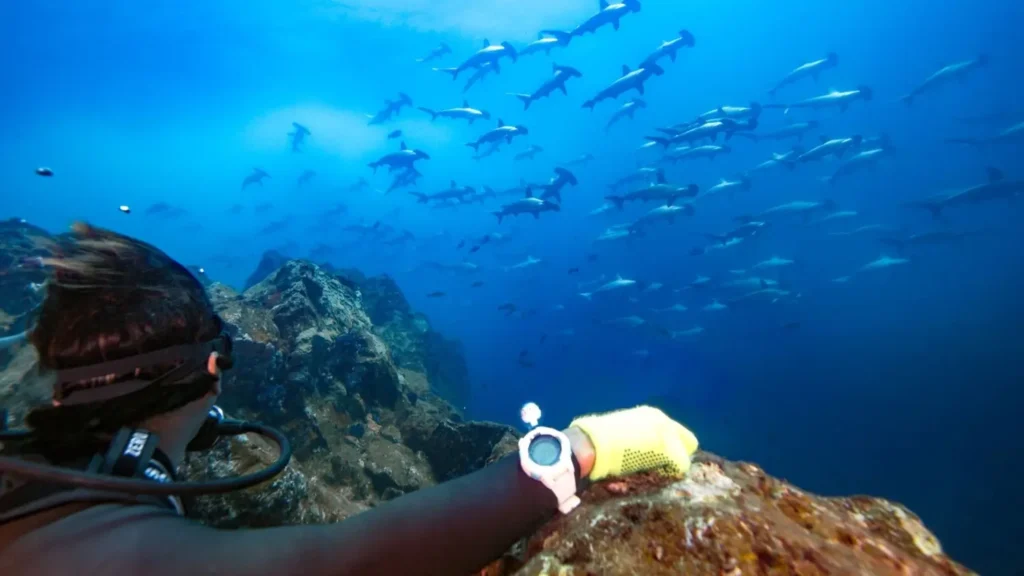
This is the main event for most. The current brings schools of hundreds of scalloped hammerheads. They generally swim against the current, allowing divers tucked into the reef to watch them pass like a parade. The stronger the current, the lower and closer the sharks tend to swim.
The Giants: Whale Sharks
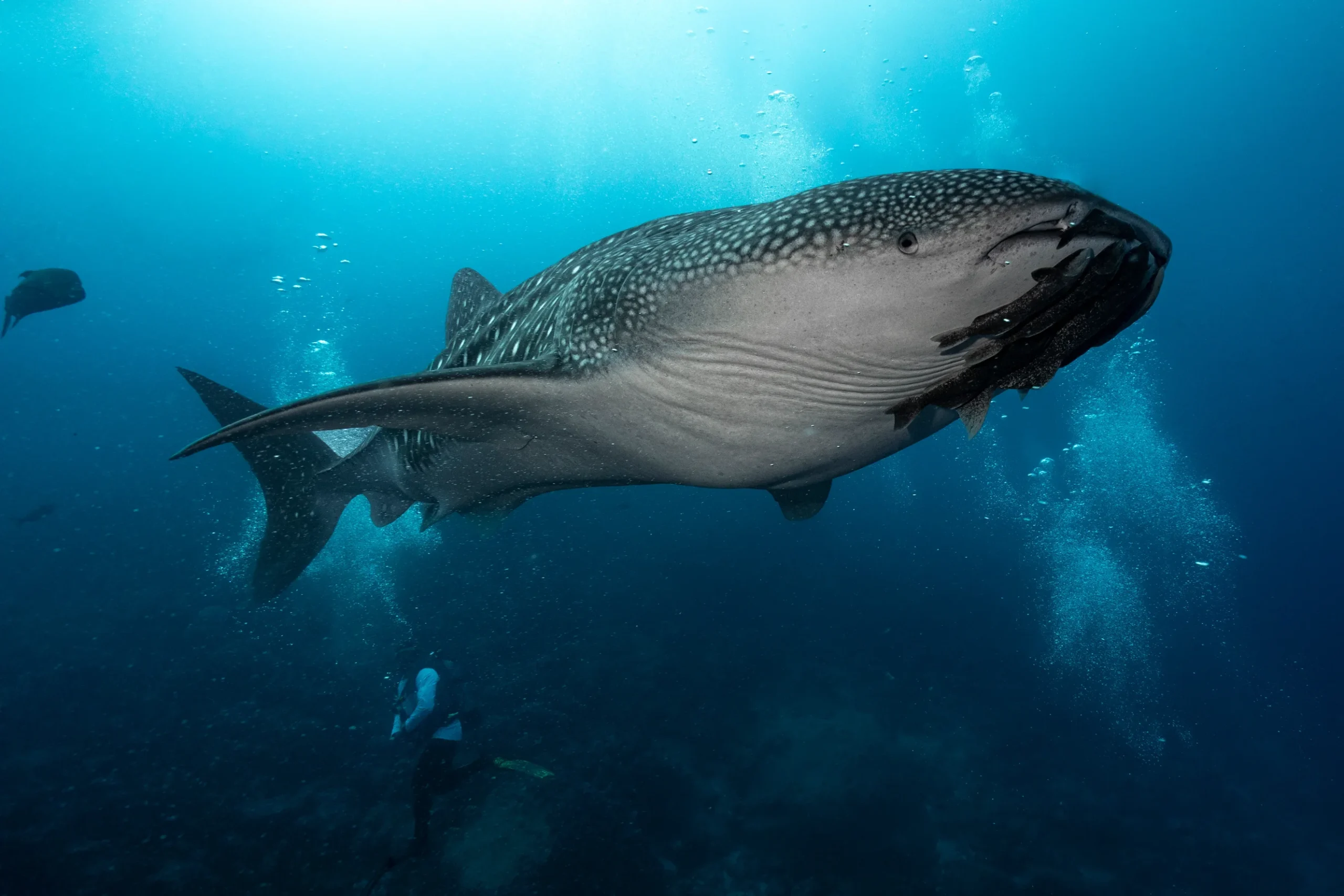
From June to November, the whale sharks arrive. These are typically very large females, often among the largest whale sharks divers will ever encounter. They cruise effortlessly through currents that divers struggle to battle.
Technical Tip: Do not chase. You cannot outswim a whale shark (you can’t, don’t even try, just trust us), and swimming away from the reef into the blue to get a photo can lead to “blue water drift,” separating you from the group.
The Supporting Cast
Expect Galapagos sharks, silky sharks patrolling the blue, massive schools of yellowfin tuna, and eagle rays. The density of life here is overwhelming.
Essential Skills for Diving Darwin’s Arch
Before booking a trip to the Galápagos, assess your readiness against this checklist.
- Drift Diving Proficiency: Comfortable with rapid movement and a lack of fixed visual references.
- Buoyancy Control: Ability to maintain depth within 1 meter, even when the water column is shifting.
- SMB Deployment: You must be able to deploy a Surface Marker Buoy (SMB) from depth, in current, without shooting to the surface.
- Negative Entry Confidence: No hesitation on the roll. Just go go go!
- Navigation: Understanding where the reef is relative to the blue water drop-off.
- Physical Fitness: The ability to fin hard for short bursts if caught in a downcurrent or to reach the reef.
Note: Advanced Open Water is the certification baseline, and Master Liveaboards also requires a minimum of 50 logged dives. Experience in cold water and currents is strongly recommended.
A Dive Day at Darwin’s Arch aboard Galapagos Master
On Galapagos Master, the rhythm of the day is dictated by the sun and the tides.
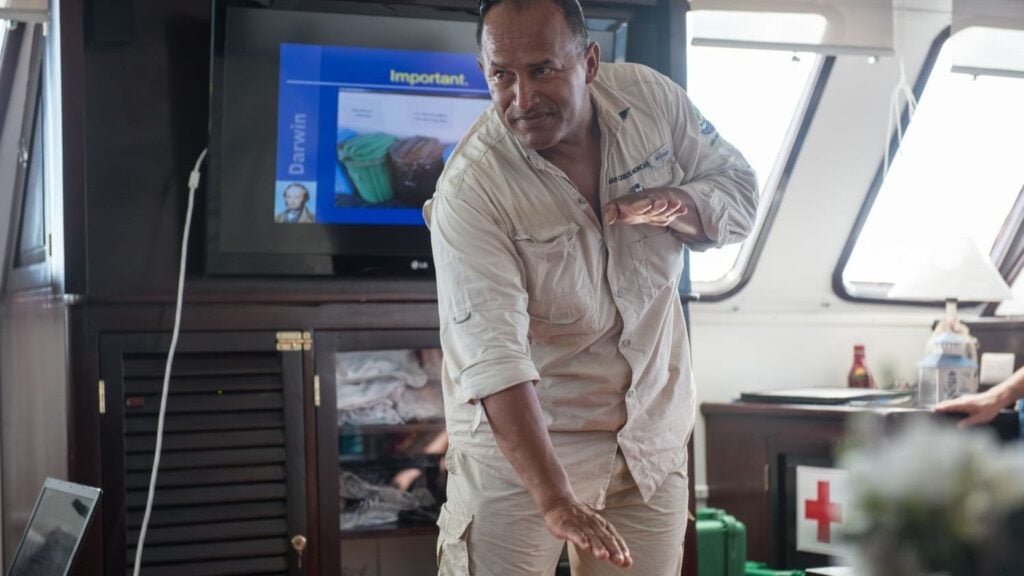
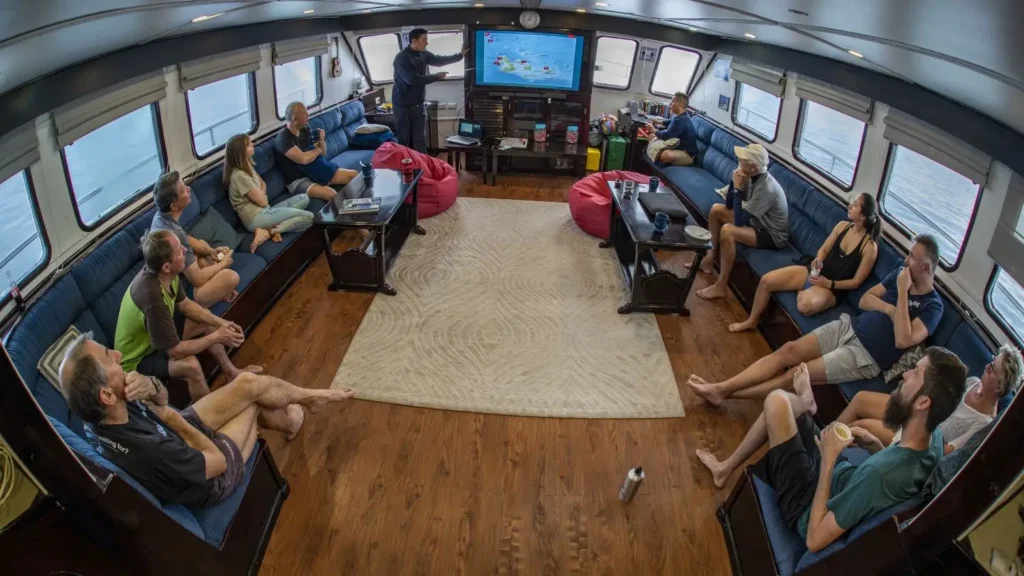
It begins with an early briefing. Our expert dive guides analyse the morning conditions, checking the direction of the current and the swell height. The briefings are detailed, covering specific drop points and lost-diver protocols.
Divers gear up on the dive deck, specifically designed for heavy-gear setups. From there, it is a short ride on the tenders to the Arch.
Between dives, the surface intervals offer their own magic. You might see pods of dolphins breaking the surface or frigatebirds circling the boat. The atmosphere, as always on a liveaboard, is one of camaraderie. There’s a shared respect among advanced divers who have witnessed the raw power of nature.
For a deeper look at how we structure our expeditions, review our itineraries:
Safety Protocols: What Makes Darwin’s Arch Advanced
Safety at Darwin’s Arch is active, not passive. The Galapagos Master crew employs strict protocols to manage the risks associated with this high-energy site.
The “Blue Water” Protocol
If a diver is blown off the reef into the blue, they must not fight it until they exhaust their air. The protocol is to drift, deploy an SMB immediately, and wait for pickup. The panga drivers know what can happen here and will be on alert for the duration of the dive. It’s all in a day’s work for them to track the bubbles and the SMBs.
The Buddy System
In low-visibility or high-current situations, separation is a real risk. “Same ocean” buddy diving is not enough here; you need to be within arm’s reach or visual lock at all times.
Electronic Safety
We highly recommend (and provide free rental of) Nautilus Lifeline GPS units. In the event of a surface drift away from the main site that is not spotted, these units broadcast your GPS position to the Galapagos Master bridge.
Why Choose Galapagos Master?
When diving a site as demanding as Darwin’s Arch, the vessel you choose is part of your safety equipment.
Galapagos Master is a steel-hulled vessel, offering superior stability in the choppy waters often found in the northern islands. Our indoor camera station with individual charging points ensures your equipment is ready for the shot of a lifetime, while the dive deck provides ample space for gearing up without crowding.
Most importantly, our crew has years of experience specifically in these waters. They know how the currents shift with the tides and how to drop divers safely for the best possible encounters.
Ready to Take on Darwin’s Arch?
Darwin’s Arch is not just a dive site; it is a rite of passage. It is where experienced divers come to test their skills, witness extraordinary marine life, and feel the pulse of the planet.
It requires respect, preparation, and the right support team. When you are ready to master these currents and witness the theatre of evolution, Galapagos Master is ready to guide you there.
Frequently Asked Questions
Minimum Advanced Open Water and a minimum of 50 logged dives. Master Liveaboards strongly recommends Deep Diver and Drift Diver specialties, along with recent experience in similar conditions.
Highly. To maximise your bottom time at 18 to 25 meters where the shark action is, Nitrox is virtually essential.
They vary, but 3 knots is very common and can peak as high as 5 knots. It is often too strong to swim against.
The “Whale Shark Season” generally runs from June through November, coinciding with the colder Humboldt current.
Yes, but you must have excellent buoyancy. If the camera affects your safety or ability to manage the current, you may be asked to leave it behind for a check-out dive.
About the Author