
The more you know about each Truk Lagoon wreck, the more you will get out of your liveaboard holiday. Today, dive right into the wreck of Hoki Maru. Discover her history and what makes her a must-see wreck!
Quick facts
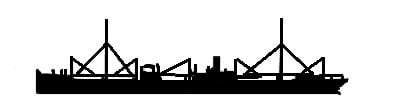
| LENGTH | 137 meters |
| GROSS TONNAGE | 7112 tons |
| DEPTH AT THE BOTTOM | 50 meters |
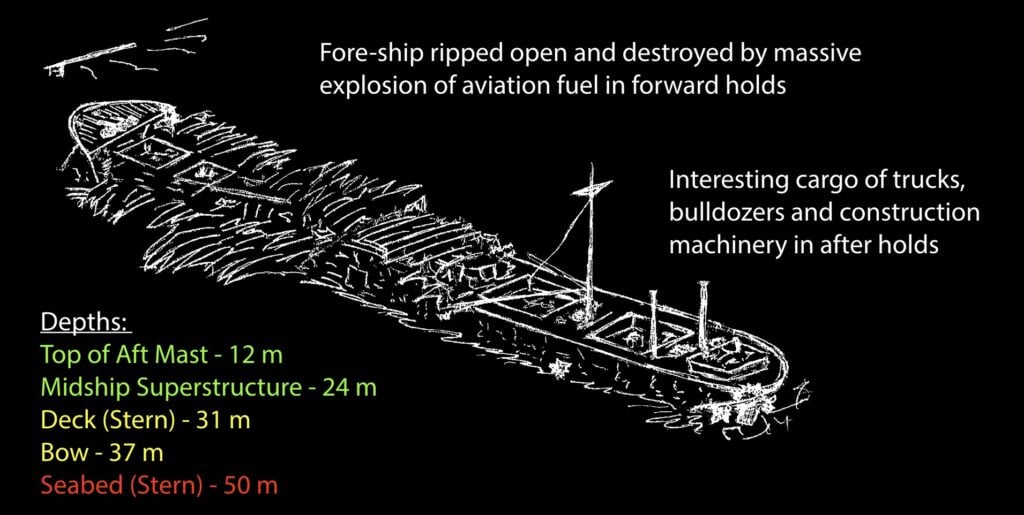
| DEPTH MAIN DECK | 24 to 37 meters |
| DEPTH SHALLOWEST POINT | 12 meters |
| ACCESSIBILITY | All levels of divers |
The foreign birth
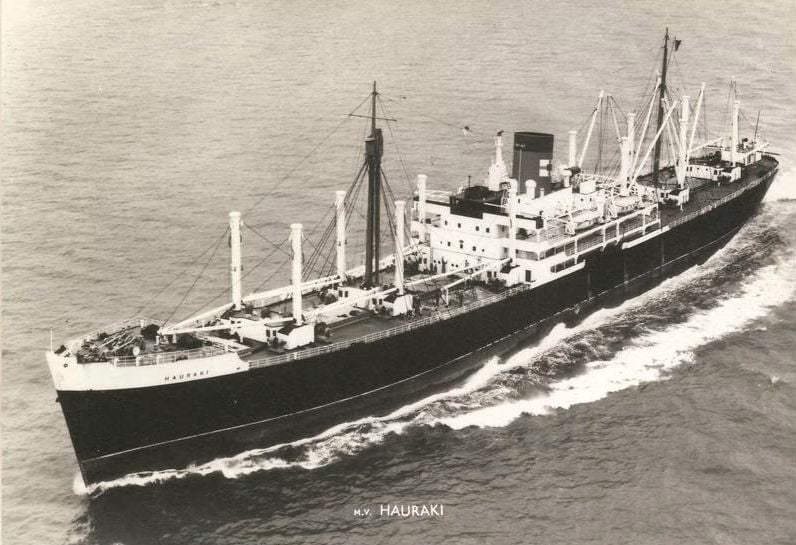
Contrary to many of the other Japanese Marus, the Hoki Maru started its life in Dumbarton, Scotland. William Denny and Brothers Limited built it in 1921 for the Union Steamship Corporation of New Zealand (USSCo). It was the 41st ship they were building for this company, but this one was a bit unusual. It is an early motorship with two large 8 cylinder 4 stroke diesel engines originally with blast injection.
The transport ship officially launched on 28th November and named M/V Hauraki . The USSCo operated it as a passenger/cargo ship with accommodation for 12 passengers. It was their first motor ship using 14 tons of oil fuel per day.
The ship was mainly on the North American service, visiting frequently Canada, USA and Australia. USSCo continued operating it until 1940. In 1936, the M/V Hauraki even made the news by having the distinction of carrying the first Douglas DC2 as deck cargo from the USA to Melbourne for Holman Airways.
Drafted for the war effort
In 1940, her years as civilian ship ended when the British Ministry of War requisitioned it for the war effort. She then was mainly doing transport between Australia (Sydney or Melbourne) to Aden (Yemen) and Port Said (Egypt) bringing much needed war supplies to the Allied troops stationed in North Africa.
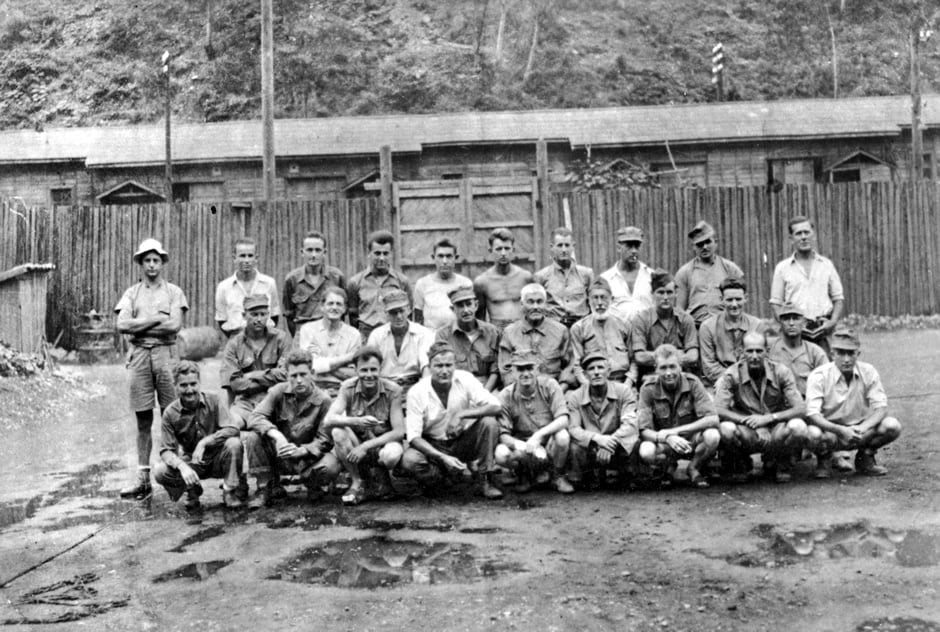
On one of such rotation, she left Freemantle in Australia to head to Egypt, loaded with supplies. The transport ship stopped in Colombo, Sri Lanka. Shortly after leaving that port, the Imperial Japanese Navy IJN ships Hokoku Maru and Aikoku Maru captured her on 12th July 1942.
After her capture, a Japanese crew from the Hokoku was put aboard. The deck crew were locked below, but the engine crew were engaged, under guard, to run the ship’s machinery. In the course of the voyage back to Japan, the engine crew managed to pitch most of the spare machinery parts over the side. As a result, the Japanese never obtained much use from the ship. All 55 crewmen were taken to the Changi Prison (civilian) in Singapore. 23 men were retained as crew to take the “prize” back to Japan. All 23 ended up on Tokyo Dispatch POW Camp #1. When the camp closed, the 22 survivors were placed in POW Camp Sendai #5. Two more died here during shelling.
The end of the Hoki Maru
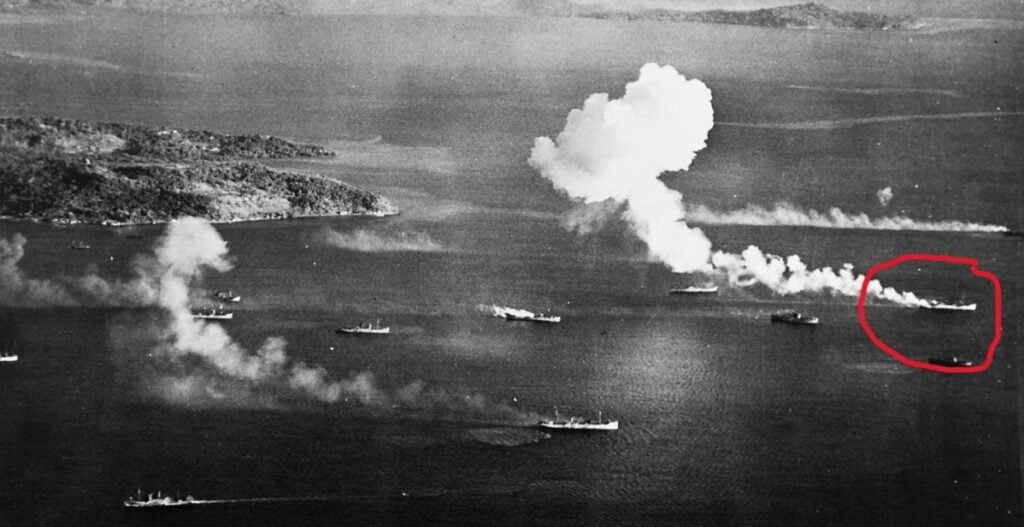
The IJN officially renamed the vessel Hoki Maru in September 1942 and used it as a transport ship, mainly in South-East Asia. That is until January 1944 when the IJN assigned her to the operations in the Pacific. She left Japan on 20th January as part of convoy No. 3120. Another famous Truk Lagoon wreck, the San Francisco Maru, was also part of that convoy. They were harassed all the way to Truk by submarines.
On 17th February 1944, Operation Hailstone started. Bombers from the USS Essex and USS Yorktown and torpedo planes from USS Bunker Hill hit the Hoki Maru. The bombs unfortunately hit the aviation fuel stocked in the forward holds. This resulted in a massive explosion that ripped open the fore-ship and mid-ship sections. The Hoki Maru sank to its final resting place along with 23 of her crewmen. Ironically the Hoki Maru sank less than a mile from the Aikoku Maru, which had been her capturer.
Dive on the wreck of the Hoki Maru
Divers discovered the wreck in 1973, but they could not immediately identify it. They nicknamed it “The Bulldozer Ship” because of the cargo of bulldozers aboard.
She nowadays sits upright and is accessible to all divers, recreational or technical. We pretty much always visit her on our cruises onboard Pacific Master. Her cargo is fascinating and this makes this wreck a unique wreck. She sits in an area of the lagoon that receives a fresh supply of water from outside the lagoon. This means that not only, you can have exceptional visibility but also that the marine life is stunning.
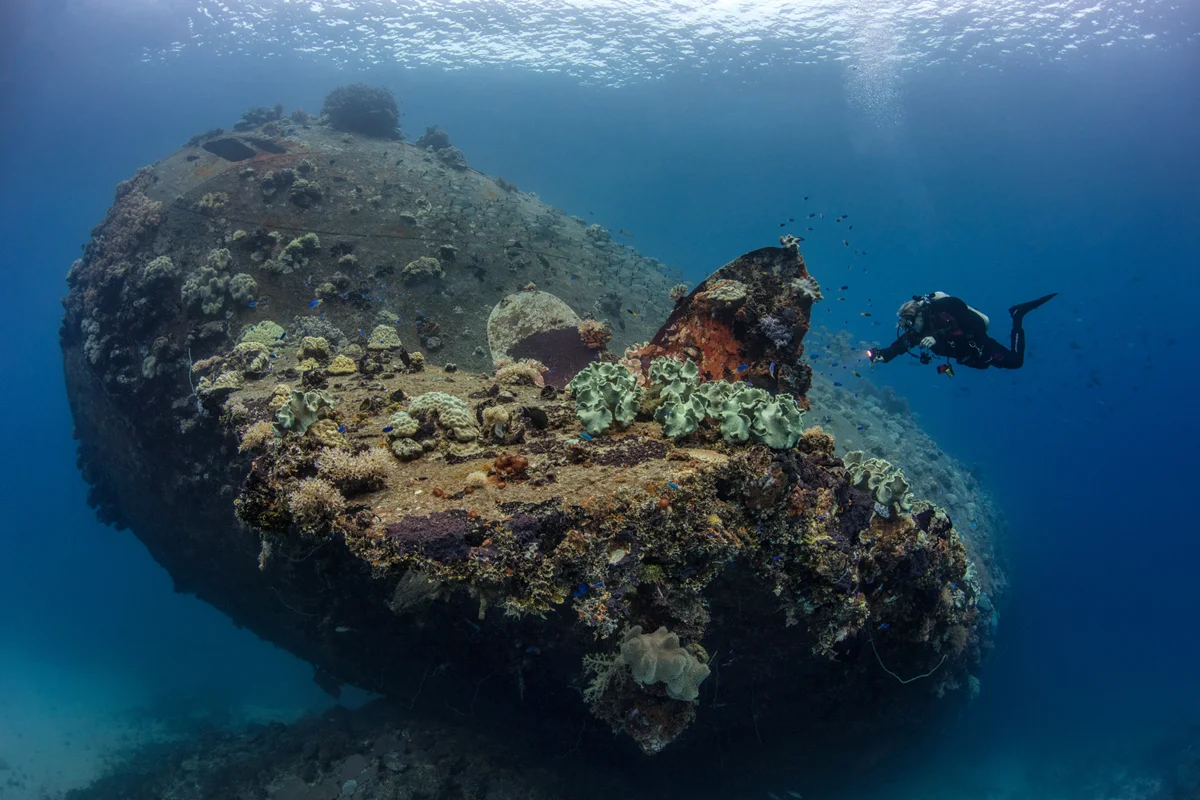
As you descend, it becomes very obvious what she went through. The fore-ship section is pretty much all destroyed due to the explosion. We normally descend along her remaining mast until you reach the main deck at around 30 meters. Right behind the mast, you can see hold number 4.
Hold no. 4
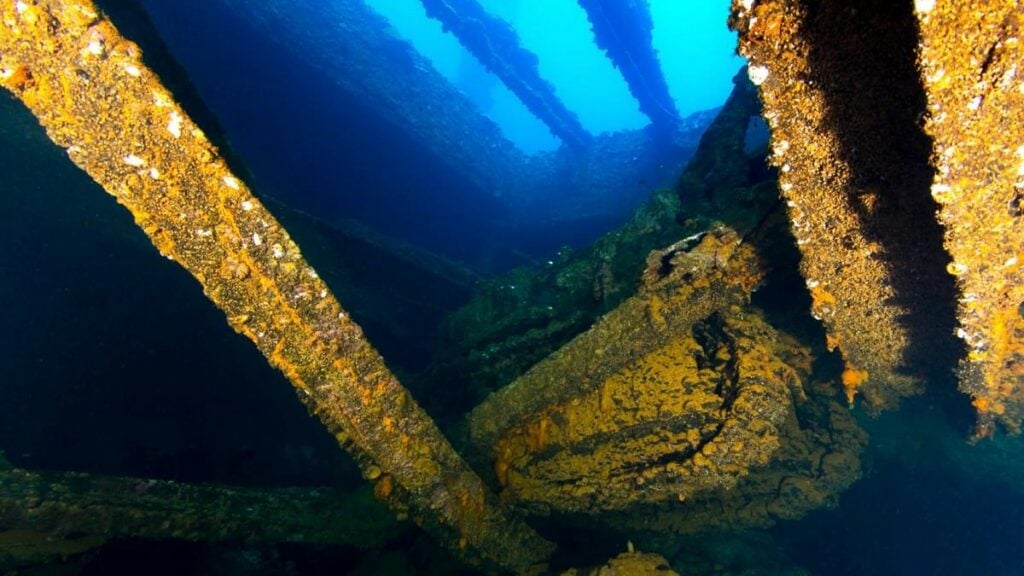
The hold is definitely worth your time and providing your training allows it, do spend time exploring it. Do be aware that It is quite cramped in it. They tried to maximise the cargo space at the time! You will need a torch and do be very careful with silting. The tight hold means that silting is an issue. Even with good finning, as soon your exhale, your bubbles hit the ceiling. And that dislodges particles that get further stirred up by divers. It is still covered by the supporting beams but as the wood has rotten away, you can easily peer in to see the treasures below.
Right there, on the middle level, you will see the remains of the famous bulldozer. Over the years, the weight of the bulldozer has been pressing on the beams and you can see them bent.
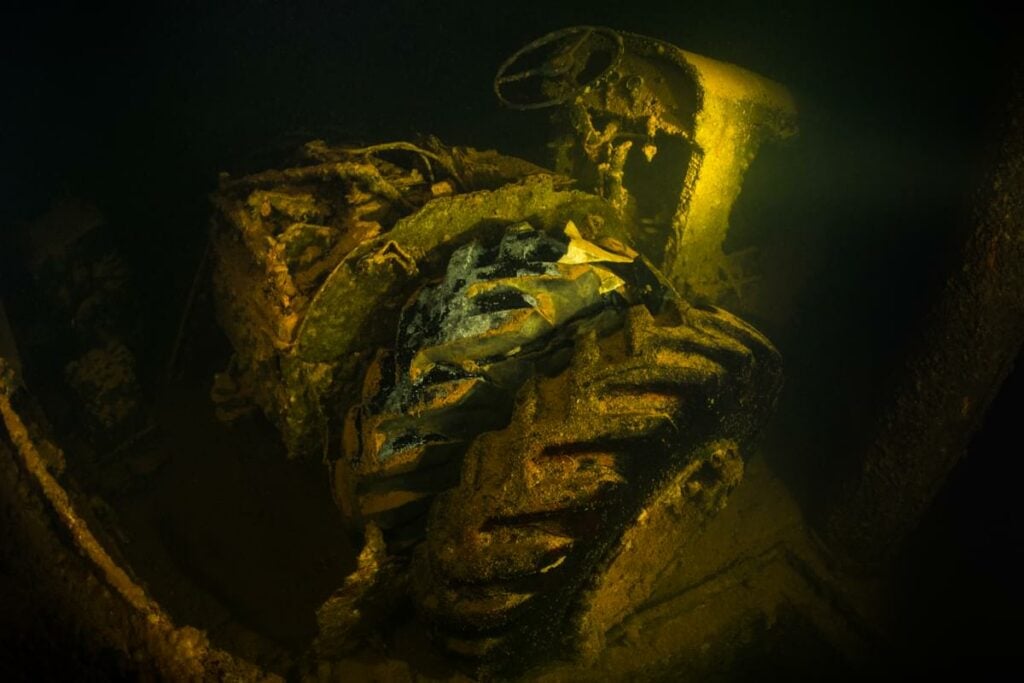
Other than the bulldozer, you will also find several pickup trucks. Even after all this time underwater, they are in excellent condition. Most of them are all complete with mudguards, steering wheels, pedals, gear stick, headlights and tires. Some still have glass in their side windows. The seat cushions have of course rotten away but you can still see their springs.
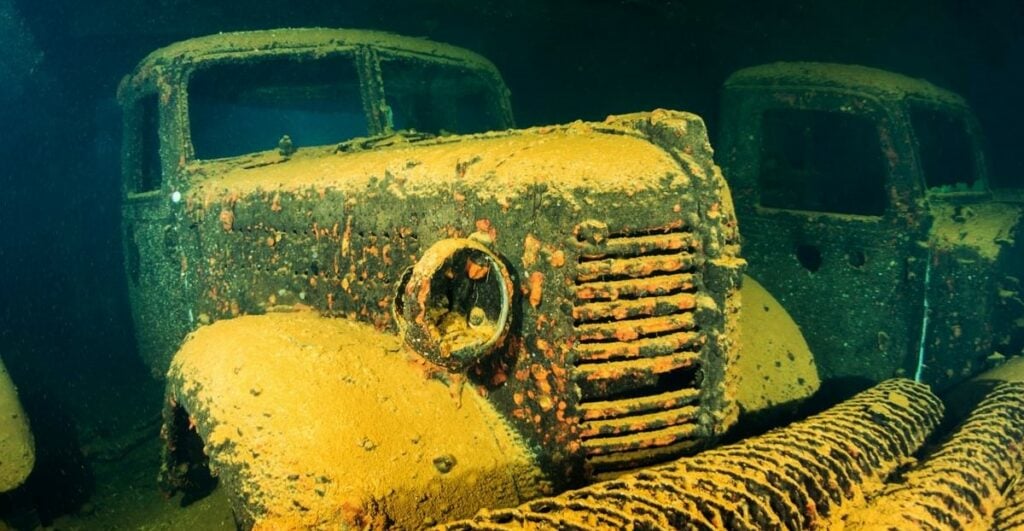
A bit further in, You will find a tractor complete with steering wheel and seat. Oddly, the treads on the tires are mounted backwards. This may be because the tractor was to do more pulling than pushing, or simply, it was an error. Soon enough, due to depth, you will need to exit the hold. As you do so, make sure to pass by the steam roller.
Main deck and fore-sections
Once you left that hold, make your way towards the bow. The wreck has become a splendid artificial reef and swimming over the decks is almost like swimming along the reef. Do keep an eye out for some Napoleon wrasses, schools of batfishes or trevallies hunting.
As you make your way forward, the wreck will look less and less like a ship. Everything is bent, twisted or simply flattened out. The hull was bent outwards by the force of the explosion.
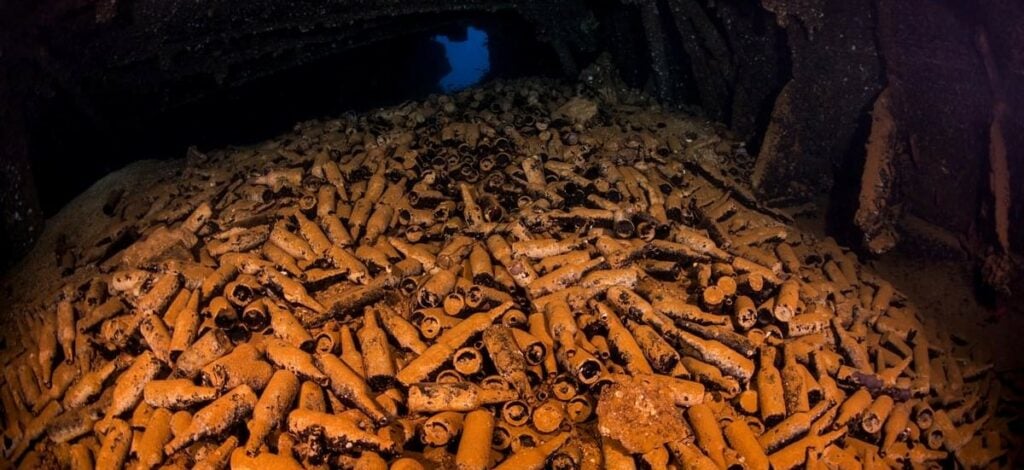
That section may seem like a pile of metal but does have 2 points of interest. In the amidship secion, you can find the brass plate showing the ships details and launch date. The second amazing sight are the beer bottles. Under some debris, you will find thousands and thousands of beer bottles. It is suspected that the bottles were in crates (that have rotten away now) and stored in hold no. 2. You can still read imprinted in the glass the name of Dainippon Brewery Co.
The Hoki Maru is a unique vessel in the lagoon. Her history is fascinating and just diving on is a strong reminder of the war atrocities. A very humbling dive that shows though that nature always have the last word.
For more information about diving the Hoki Maru and other shipwrecks of Truk Lagoon, please contact us.
About the Author